
Custom Jewelry Manufacturer Selection: Compliance First
Selection usually starts with price and ends with a compliance problem. Reverse the order: check the restricted-substances position before the sample, because the published material statement here covers lead, cadmium and nickel, and the smallest order that can carry it is 50 pieces per design in 925 sterling silver. Compliance decides what you are allowed to sell; the minimums only decide how much of it.

Key takeaways
- Screen the materials statement first: REACH compliance covering lead, cadmium and nickel, plus plating declared compliant with REACH and California Proposition 65.
- Add the ISO 9001:2015 quality system and the BSCI social audit to the same first-round checklist.
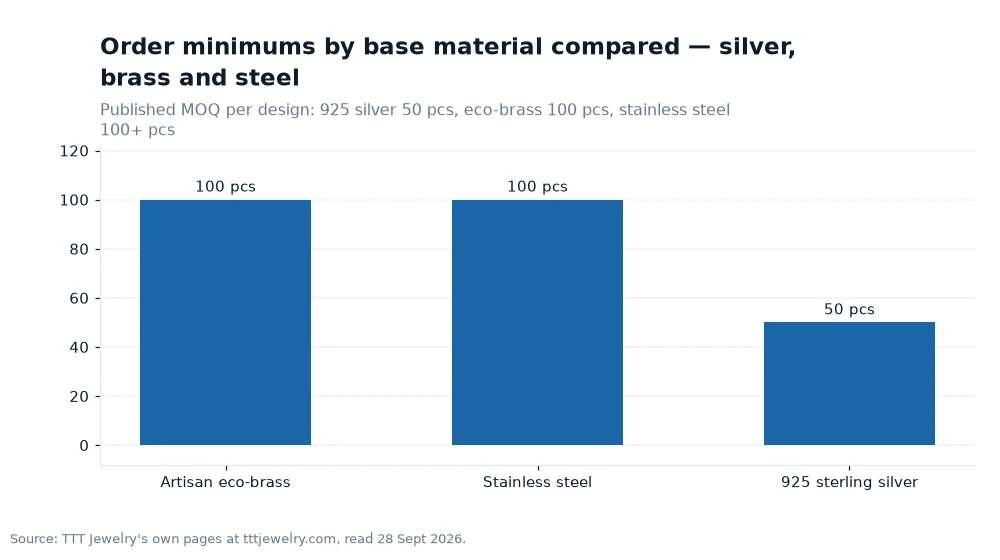
- Entry quantities are 100 units in artisan eco-brass, 100+ pcs in stainless and 50 units in 925 silver, per design, applied design by design.
- Confirm the finish route per metal: anti-tarnish e-coating for silver and brass, PVD vacuum plating for stainless steel.
Why compliance belongs in the first email
Price can be negotiated at any point in a project. A restricted substance cannot be negotiated at all, because it is a property of the metal and the coating rather than a commercial term. Sketches, reference photos and tech packs are all accepted as starting material, so the first message is also the least costly moment to ask for the materials documentation.
Doing it in this order changes the shortlist. Suppliers who can produce the documents immediately move forward, and suppliers who need to check move down, without a single sample having been made. It also sets the tone of the relationship: a workshop that answers a documentation request in a day is telling you how it will answer a production problem later.
It is the same moment to settle the OEM/ODM question, because the two routes carry different paperwork. A supplier building to a buyer's own CAD file still has to declare the same alloys and the same coatings as one developing the design from a mood board, so the compliance file maintained by TTT Jewelry is written per base material rather than per customer.
The three statements worth reading in full
First, the materials statement: the metals used are free from lead, cadmium and nickel, and the plating is declared compliant with REACH and California Proposition 65. Second, the quality system: ISO 9001:2015, which means the process is documented and repeated across all production stages rather than left to whoever is on shift. Third, the social audit: BSCI, covering a traceable, ethical supply chain, workplace safety and documented labour practices.
Read all three together rather than picking one. A compliant alloy finished in an uncontrolled workshop, or a well-run workshop using an unrestricted alloy, both leave a brand exposed in the same way.
How the minimums line up with the compliance work
Each base metal carries its own finish logic, and that logic is what makes the minimums differ. A brand comparing quotes across materials should read the two columns together, because the minimum is a consequence of the coating route rather than a negotiating position.
| Base material | Minimum per design | Finish route |
|---|---|---|
| 925 sterling silver | 50 pcs | 14K / 18K / 24K gold or rhodium plating, plus anti-tarnish e-coating |
| Artisan eco-brass | 100 pcs | Multi-layer precious metal plating, plus anti-tarnish e-coating |
| Stainless steel | 100+ pcs | PVD vacuum plating |
| Hallmarks available | Applies to all three | 316L on stainless, an 18KGP mark on plated work and S925 on silver applied by laser engraving |
Where the minimum and the finish meet
The minimum is not a sales threshold, it is the quantity at which the tooling and the plating batch make sense. Silver is the least costly material to take through casting and needs the smallest run, so it starts at 50 pieces. Brass is a base metal that only reads as a finished product once it carries a plating stack and a protective anti-tarnish layer, so a first run is 100 pieces. Stainless steel is machined and finished in a vacuum chamber, which pushes the entry quantity to 100+.
Compliance work sits on top of all three. Every finish listed in the table has to be declared, and the declaration is what your retail customers will ask to see when they run their own supplier checks.
A four-step screening order for a new supplier
Step one: ask for the materials statement and the quality certificate in the same message, because a supplier who sends neither is not a candidate. Step two: cross-check the minimum against your first range, using the material that matches your price point. Step three: test the process description by asking where inspection sits, since 100% inspection before packing is a claim that can be traced to a specific stage. Step four: ask who owns the design and the tooling, where the published answer is 100% NDA with the collection kept exclusive to your brand.
Four steps, no sample required, and the shortlist is usually down to two names within a week.
Worked example: minimums as the size of your first commitment
The published minimums can be compared directly, since they are all quoted per design. Silver starts at 50 pieces and brass at 100, so the silver minimum is 50 ÷ 100 = 0.5 of the brass minimum, in other words exactly half. Stainless steel sits at 100+, which is at least 100 ÷ 50 = 2 times the silver minimum.
Scale that to a launch of three designs. Three silver designs need 3 × 50 = 150 pieces. Three brass designs need 3 × 100 = 300 pieces. Three stainless designs need at least 3 × 100 = 300 pieces. The choice of base metal therefore doubles the quantity you commit to before a single price is discussed, which is why the material decision belongs before the costing conversation and not after it. The published minimums are the manufacturer's; the multiplication is mine.
Frequently asked questions
What should be checked before requesting a sample?
The materials statement first, covering lead, cadmium and nickel and naming the plating as compliant with REACH and California Proposition 65, together with the ISO 9001:2015 certificate and the BSCI audit report.
Which material has the lowest entry quantity?
eco-brass, stainless work and 925 sterling silver.
Does the minimum change if the design is complex?
The published minimums are stated per design by base material, and complexity affects the production schedule rather than the entry quantity, so the 50 / 100 / 100+ figures are the ones to plan against.
Putting the checklist in front of the quote
Compliance first, minimums second, price third is a sequence that saves months. A supplier that clears the first two rounds has already told you how it documents its process, and the costing conversation becomes a normal commercial discussion instead of a discovery exercise. The materials and finish options are catalogued on the wholesale customisation page, while the coating behaviour of each metal is described in the silver plating notes.
What this article works from — the 24-hour response commitment, then the eight production stages plus the six customisation points — is written up at the client's own website through tttjewelry.com on 28 Sept 2026. The 24-hour reply commitment is quoted alongside the route: first response inside a working day. The unit conversions are my own construction — the site supplies the inputs only [1]