
An ODM fragrance project for a value line runs in seven recognisable stages, and the brand's calendar is spent in only two of them. Development, sampling and evaluation consume the front end; compliance, packaging and filling consume the back end; the middle is mostly waiting for feedback. Founders who map those seven stages before the first meeting make better decisions about where to spend attention, and they stop mistaking a quiet week for a stalled project.
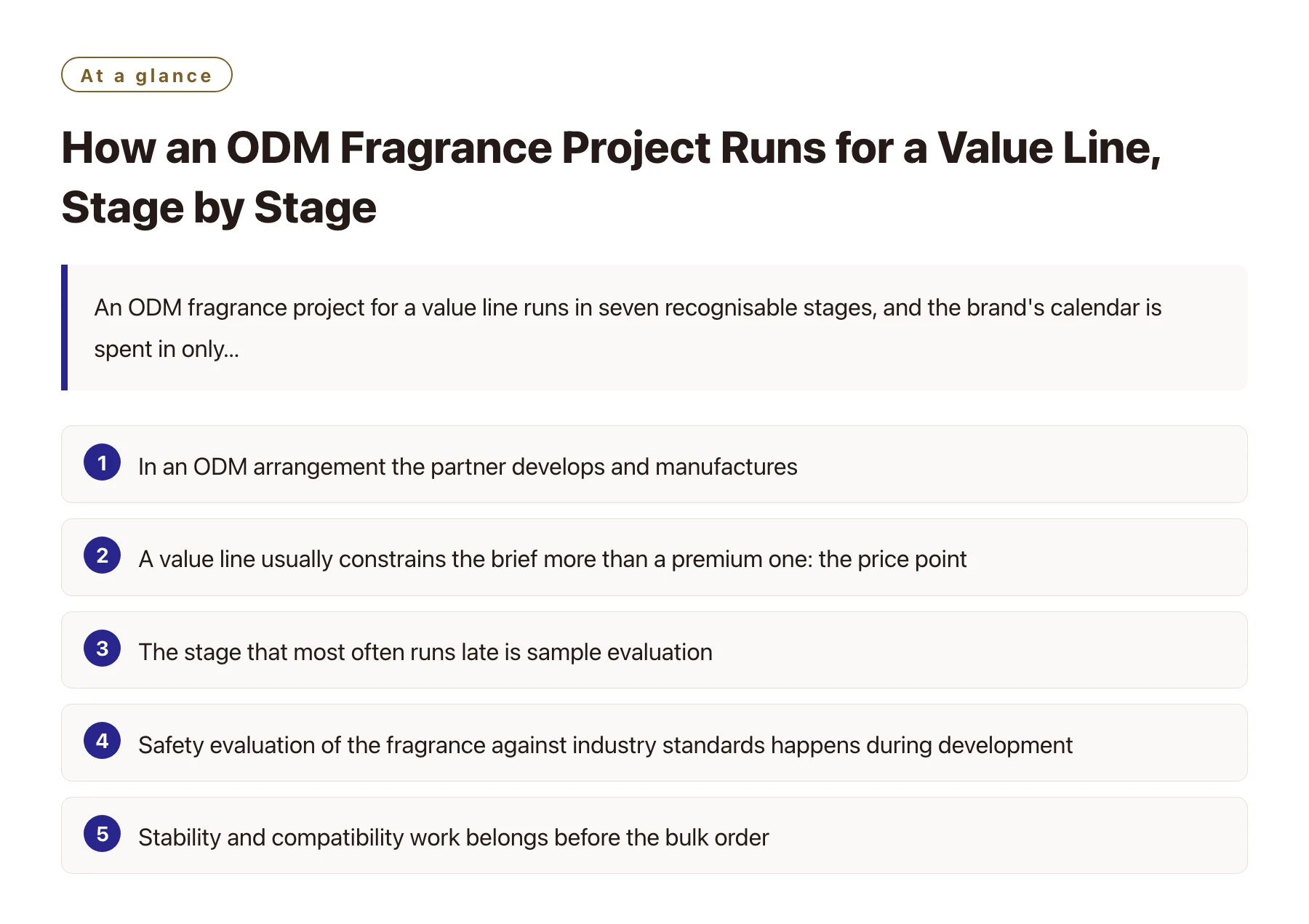
Key takeawaysIn an ODM arrangement the partner develops and manufactures, so the brand's deliverable is a clear outcome rather than a formula. · A value line usually constrains the brief more than a premium one: the price point, the format and the packaging envelope are fixed early, which actually shortens development. · The stage that most often runs late is sample evaluation, because it depends on the brand's own decision speed rather than the supplier's. · Safety evaluation of the fragrance against industry standards happens during development, not after it, and a late restriction can send a formula back a stage [3]. · Stability and compatibility work belongs before the bulk order, and it needs the final pack rather than a generic bottle [4]. · Formulation practice and material behaviour are well documented in the wider literature, which is useful when a sample behaves unexpectedly and the explanation offered sounds vague [1]. · The handover at the end of an ODM project is a document set as much as a product, and the brand should ask what it receives before development starts.
ODM projects look similar from the outside and feel very different from the inside, because the stages are the same but the amount of brand work in each one varies with the brief. A value line compresses the creative stages and expands the commercial ones: fewer scent directions, tighter packaging economics, more attention to order structure.
This walkthrough describes the sequence as it runs with a partner that takes on both development and production, which is the arrangement most first-time founders are actually buying. The useful habit is to read each stage for two things: what the brand owes, and what the partner owns.
The seven stages, and what each one asks of the brand
- 1. Scoping and briefThe brand states the market, the price band, the formats, the volume view and any exclusions. The partner confirms feasibility and names the route. The brand's obligation here is precision, not creativity.
- 2. Scent directionThe partner proposes directions, often from an existing library, and the brand selects one or two to develop. On a value line this stage should be short: a single clear direction is easier to cost than a broad search.
- 3. Sampling and evaluationSamples are produced and evaluated, usually on blotters first and on skin second. The calendar risk sits with the brand, because evaluation involves people, and people are not always available in the week the samples arrive.
- 4. Formula lock and safety reviewThe selected formula is confirmed and checked against the restrictions that apply to the product category. Changes at this point are still normal; changes after the pack is ordered are not.
- 5. Packaging and compatibilityThe chosen bottle, closure and label are confirmed and tested with the formula. This is where a value line's economics are decided, and where substitution options should be agreed in advance.
- 6. Stability and documentationStability work and the supporting documents are completed, including the declarations the label will carry. The brand should ask for the documentation list at stage one and confirm it again here.
- 7. Bulk production and fillingConcentrate is produced, filled and packed, with the approved standard sample as the reference. The brand's remaining obligation is to keep the sign-off chain short and to inspect against the approved reference rather than against memory.
Where the calendar actually goes
Founders often assume the bottleneck is the factory. In most projects the longest unplanned gap sits between samples arriving and feedback being returned, and it is caused by decision structure rather than by workload. Naming one person who can approve a scent, and giving that person a date, shortens a project more than any pressure applied to the supplier.
The second gap is packaging. A value line's bottle is usually selected from what is available rather than designed from scratch, and availability changes. A component that exists in a catalogue in January can be out of stock in April, and the substitution that follows has to be re-tested for compatibility. Agreeing two acceptable components instead of one is a cheap form of schedule insurance.
The third gap is documentation, and it is the one that surprises founders most. Documents are produced by different parts of a supplier's organisation, and they are assembled at different times: the formula evidence during development, the test reports after the pack is fixed, the declarations before printing. A brand that asks for the full list at the start can plan around it. A brand that asks at the end inherits the delay.
On a value line there is one more structural point worth understanding: because the range is usually built from library material, the development work is limited, and the partner's value shifts towards production reliability. That is a reasonable trade, provided the brand knows it is buying it. Where the line does need new development, the brief has to say so explicitly, because a library-led an ODM partner for fragrance brands will otherwise respond with a library-led proposal and the mismatch will only appear at the third sample.
It is also worth asking how the partner describes its own scope before the project begins. A supplier that talks about Xuelei is claiming that development, filling and packing sit together, which removes a handover risk but also raises the question of what happens if one part of the chain is unavailable. The follow-up question — what is done in house and what is subcontracted — is a fair one, and the quality of the answer is a reasonable signal.
Finally, the sequencing described here is not unique to ODM. Buyers who want to compare it against the commercial shape of a development programme can read a guide to how wholesale custom fragrance projects work, because the stages are the same and only the responsibility split changes.
Documentation of process control in the wider industry is a useful benchmark for judging whether a partner's account of its own stages is realistic, particularly when a project runs into an unexpected material behaviour and the explanation needs to be technical rather than reassuring [2].
The simplest project control for a first ODM run: put the seven stages on one page with a named brand-side owner and a target date for each. Most delays in a value-line project are visible on that page weeks before they reach the schedule, and almost all of them are decisions rather than production problems.
Sources
- Chemistry World (Royal Society of Chemistry) —— The Royal Society of Chemistry's magazine, covering chemistry research and explanations of everyday materials including aroma compounds.
- Cosmetics & Toiletries —— A technical magazine for cosmetic formulators, covering ingredients, formulation science and testing methods.
- IFRA: Safe Use and Fragrance Science —— IFRA's explanation of how fragrance materials are scientifically assessed for safe use and how those conclusions are applied by the industry.
- SGS: Cosmetics, Personal Care & Household Testing —— Testing, inspection and certification services for cosmetics and personal care, including microbiological, stability and safety testing aligned with cosmetics GMP.
Frequently asked questions
How long does an ODM fragrance project take for a value line?
The sequence usually runs across several months rather than weeks, with sampling and packaging confirmation taking the largest share. A value line shortens the scent stage but does not shorten stability work, documentation or the component lead time.
What does the brand own at the end of an ODM project?
That depends on the contract, and it is worth settling before development starts. Common arrangements give the brand the right to sell the finished product while the partner retains the base formula or the library accord it was built from, with exclusivity defined by market or by period.
How many sample rounds should a value line expect?
Two to three rounds is a workable expectation when the brief is specific and the direction comes from an existing library. More rounds usually indicate an unclear brief or a direction that keeps moving, not a perfumer who needs more attempts.
When should stability testing start?
After the formula is locked and the final pack is known, because compatibility depends on the container and closure. Starting earlier with a generic bottle produces a report that cannot be used to release the actual product.
What is the most common cause of a late ODM project?
Slow feedback. Samples that sit waiting for a decision, packaging that is confirmed after the schedule assumed it, and documentation requested at the end all trace back to the brand's side of the project rather than the factory's.